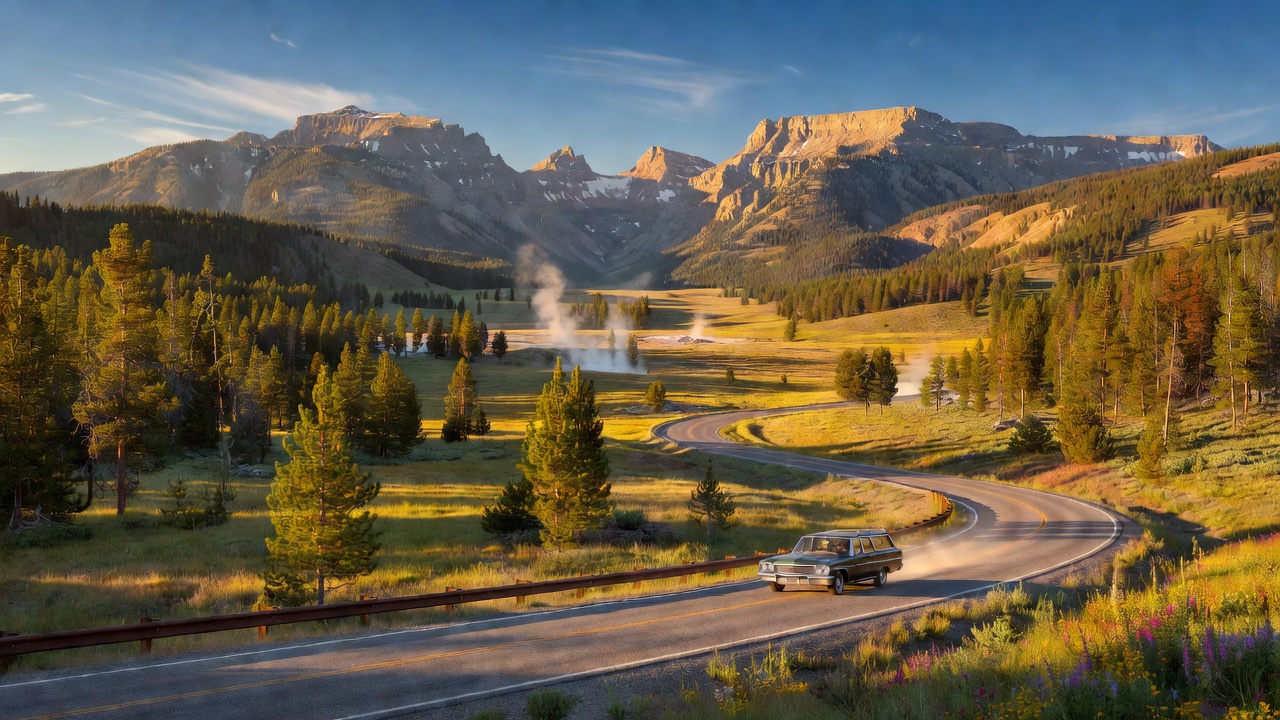
Introduction to the Route
Combining Yellowstone National Park and Grand Teton National Park into a single continuous road trip provides what is arguably the most diverse natural landscape experience in North America. Established as the world’s first national park, Yellowstone offers half of the globe’s active geysers, vast subalpine forests, and dramatic river canyons. Just miles to the south, the Grand Teton range rises abruptly from the valley floor without foothills, offering a staggering visual contrast to Yellowstone’s rolling calderas.
This combined route usually takes between seven and ten days to fully appreciate, allowing you to trace the figure-eight "Grand Loop Road" in Yellowstone before descending the John D. Rockefeller Jr. Memorial Parkway into the pristine, jagged alpine scenery of Grand Teton.
The Itinerary Breakdown
A successful trip requires breaking the drive into logical segments. The sheer scale of Yellowstone means that trying to cover too much ground in one day leads to exhaustion and missed opportunities.
Upper Loop (Yellowstone)
Beginning at the North Entrance (Gardiner, Montana), the upper loop introduces you to the Mammoth Hot Springs, where travertine terraces cascade down the mountainside. Driving eastward towards Tower-Roosevelt, the terrain becomes rugged. This segment is famous for the Lamar Valley, an expansive, open terrain bordered by mountain ranges. The northern loop then brings you down to the Grand Canyon of the Yellowstone, a staggering 20-mile-long chasm featuring the Lower Falls, dropping nearly 300 feet into the river below.
Lower Loop (Yellowstone)
The southern half of the figure-eight is heavily geothermal. Moving south from the canyon, you enter the Hayden Valley—another premier wildlife viewing location—before arriving at Yellowstone Lake, the largest high-elevation lake in North America. The route then swings westward to the Upper Geyser Basin, home to Old Faithful and the brilliantly colored Grand Prismatic Spring.
Grand Teton Connection
Exiting Yellowstone via the South Entrance, you immediately enter the John D. Rockefeller Jr. Memorial Parkway. The transition is seamless. As you drive south toward Jackson Lake, the towering peaks of the Teton Range dominate the western horizon. The Teton Park Road runs right at the base of the mountains, providing access to Jenny Lake and Signal Mountain, offering panoramic views of the entire Jackson Hole valley.
Wildlife Spotting Guidelines
This region is often referred to as the Serengeti of North America. When driving this route, the opportunities to observe large megafauna in their natural habitats are unparalleled, provided you know where and when to look.
- Bison: Abundant in both the Lamar and Hayden Valleys in Yellowstone. They frequently cross the roads, causing "bison jams." Patience is required.
- Bears: Both black bears and grizzlies inhabit these parks. Dawn and dusk are the most active times. Tower-Roosevelt and Lamar Valley are known grizzly habitats, while black bears are often seen along the roadsides near Mammoth and on the Moose-Wilson Road in Grand Teton.
- Moose: Often spotted wading in the marshy areas of Grand Teton, particularly along the Snake River and near Gros Ventre.
- Wolves: The Lamar Valley is the best place in the world to observe wild wolves. Early morning is essential, and spotting scopes are highly recommended.
Always maintain a strict distance from wildlife. Park regulations mandate staying at least 100 yards away from bears and wolves, and 25 yards from all other wildlife, including bison and elk.
Practical Driving Tips & Best Times to Visit
Driving these parks requires preparation. The speed limits max out at 45 mph, but actual travel times are often much slower due to winding mountain roads, wildlife crossings, and heavy summer traffic.
The optimal time for this road trip is late May through September. Outside of these months, heavy snowfall closes the majority of the internal park roads, including the South Entrance connection between the two parks. If you visit in May or June, you benefit from rushing waterfalls fed by snowmelt and the sight of newborn wildlife. September offers cooler weather, vibrant autumn colors, and the active elk rut (mating season), which is accompanied by the haunting sound of bugling bulls.
Cellular service is notoriously absent throughout most of the route. Downloading offline maps and carrying physical atlases is essential. Furthermore, gas stations within the park boundaries can be sparse; it is a good rule of thumb to refuel whenever you drop below half a tank.