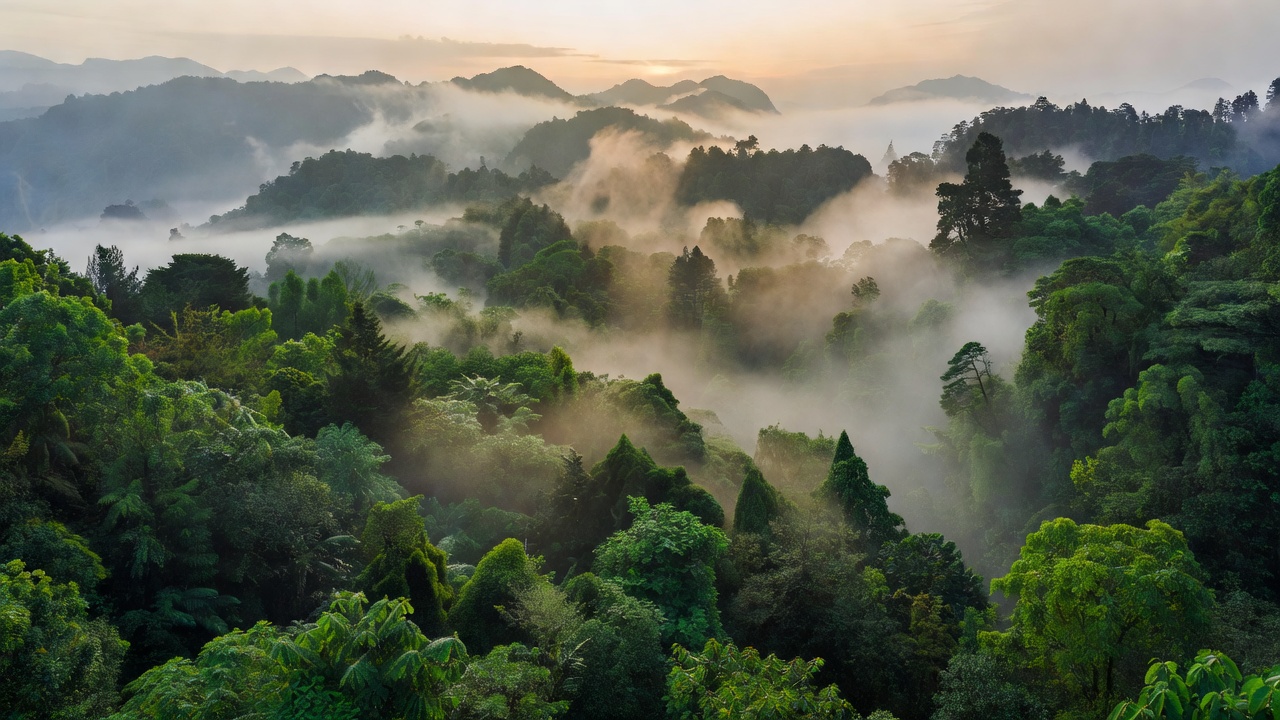
The Atmosphere of the Smokies
Great Smoky Mountains National Park, straddling the border of Tennessee and North Carolina, is a vastly different experience from the stark, rocky grandeur of the Western parks. Here, the landscape is soft, endlessly rolling, and cloaked in a dense, green canopy. The park takes its name from the persistent blue mist that hovers over the peaks and valleys—a natural phenomenon caused by volatile organic compounds released by the millions of trees.
As the most visited national park in the United States, managing your route and timing is crucial to finding solitude. A three-to-five-day trip allows you to explore the main arteries as well as the quieter, unpaved historical routes.
The Main Artery: Newfound Gap Road
The primary route through the park is Newfound Gap Road (US Highway 441), which cuts directly across the mountains, connecting Gatlinburg, Tennessee, to Cherokee, North Carolina. This 33-mile drive requires at least a half-day to properly enjoy.
Starting from the Sugarlands Visitor Center on the Tennessee side, the road begins a long, winding ascent alongside the rushing Little Pigeon River. The elevation gain is significant—over 3,000 feet—taking you through hardwood forests of oak and maple up into cooler spruce-fir ecosystems that feel more like Canada than the American South. The peak of the drive is Newfound Gap itself (elevation 5,046 ft), offering expansive views and straddling the state line.
From Newfound Gap, a highly recommended 7-mile detour takes you up Clingmans Dome Road. This road leads to the highest point in the park (6,643 ft). A steep, half-mile paved walk leads to an observation tower, providing panoramic 360-degree views of the mist-covered ridges rolling away to the horizon.
Historical Detours: Cades Cove & Roaring Fork
The Smokies are as much about human history as natural history. Before the park was established in 1934, these valleys were home to isolated Appalachian farming communities.
Cades Cove Loop Road
This 11-mile, one-way loop road is arguably the most popular destination in the park. The loop circles a broad, lush valley surrounded by mountains. Along the way, you can stop to explore preserved pioneer homesteads, log cabins, and historic churches. Because traffic moves at a crawl (often under 10 mph), allow two to four hours for this loop. Bicyclists can enjoy vehicle-free access on Wednesday throughout the summer.
Roaring Fork Motor Nature Trail
Located near Gatlinburg, this 5.5-mile, one-way loop is a narrow, winding road through old-growth forest, hugging a rushing mountain stream. It feels incredibly intimate and enclosed compared to Newfound Gap Road. It provides access to popular hiking trails like Grotto Falls and passes several well-preserved historical grist mills.
Wildlife: The Realm of the Black Bear
Great Smoky Mountains National Park is one of the largest protected areas in the eastern United States for black bears. Biologists estimate there are over 1,500 bears in the park—roughly two bears per square mile.
Cades Cove and the Roaring Fork Motor Nature Trail are prime viewing areas. Bears are most active in the early morning and late evening. If you encounter a bear while driving, pull over safely, remain in your vehicle, and do not block traffic. Under no circumstances should you feed the wildlife; a fed bear quickly becomes a dangerous bear and will often have to be euthanized by park authorities.
Timing Your Drive
The park is open year-round, but the experience changes drastically by season. Summer is lush and green but heavily congested. Autumn (mid-to-late October) brings spectacular fall foliage, drawing immense crowds; expect slow-moving traffic on all major roads. Spring offers blooming wildflowers and rushing waterfalls, while winter provides quiet, stark views through the leafless trees, though higher elevation roads like Clingmans Dome and Roaring Fork close from December through March.